Positive Dog Trainer Spotlight Series – Nancy Tucker
 According to Victoria Stillwell, “Positive-reinforcement teaching techniques use non confrontational methods to work a dog’s brain – rewarding positive behavior, establishing rituals and training actions that are incompatible with negative behavior, and lessening a dog’s anger and frustration – all while enabling the dog to feel good inside.”
I wanted to spotlight a series of colleagues and friends who use science based, positive reinforcement training.
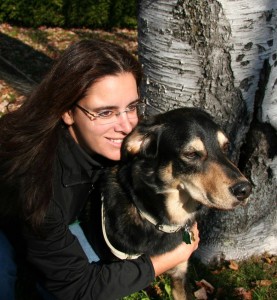
My next featured trainer is Nancy Tucker of Canada!
What was your route to positive reinforcement training?
Although I’ve never used anything other than R+ professionally, I was a user of choke collars and punitive methods with my own dogs for many years prior. It wasn’t until I adopted a dog who needed special attention that I looked into a better way to train him, and literally stumbled onto R+ information online while searching for ideas. I KNEW there had to be a better way! (I HATED “correcting” my dogs, as prescribed by all the training gurus of the 80s).
Were you always interested in science or did behavioral science peak your interest at a later time & how?
Once I learned about training using R+ (in the mid-2000s), it morphed into digging deeper and deeper into the science of learning, which of course has become an endless thirst for all things behaviour!
Are there specific skill sets from previous career paths which have aided you in your current role?
Oh my, yes! I had years of experience in the service industry (how to deal with paying customers), and several years of experience as a freelance journalist (how to ask the right questions to get to the heart of the matter), followed by several years working in Marketing & Public Relations (how to market myself as a small business owner).
What is one piece of advice from someone that you consider a “mentor” that you’d like to share?
My most favourite thing ever is a phrase I heard Dr. Chris Pachel (vet behaviourist) say at a conference once. It floored me when I heard it, because at that very moment, I had been teetering on the edge of burnout, of compassion fatigue, and what he said changed how I approached my work, and has since literally changed my life for the better (personally and professionally). He said, “I will work as hard as my client.” So simple, and so absolutely crucial to keep in mind. In this business, we pour our heart and souls into making life better for the dogs, and by extension, for our clients. If the client doesn’t put as much effort into our plan as we’d hope, it can be exhausting, worrisome, frustrating, and emotionally taxing. But in the end, you can’t worry yourself sick over things you can’t control. You have to let go, and look out for you.

What is your favorite part of your day?
Mornings. I love mornings. The earlier, the better.
What do you find to be the most challenging in working with people and animals?
I find it can be incredibly challenging at times to ensure that everyone’s needs are met, because inevitably, the needs of our human client and the needs of the dog are often very different, sometimes even at odds. It’s important to try to find the common denominator so we can nail our starting point, and work from there to make sure everyone’s happier after we’ve done our work as the hired help.
What are some key skills required for animal training?
Besides the obvious mechanical skills, I’d say: Patience. And yes, patience is a skill. It can be learned, practiced, and honed. Patience with people, and patience with dogs. Empathy, too! Lots and lots of empathy. And then some more patience. And a sense of humour!
A big, “thank you” to Nancy for taking the time to share! If you would like to learn more about Nancy you can connect with her at: www.nancytucker.ca or via www.facebook.com/NancyTuckerDogs
Note: For anyone out there who is looking to become a certified, professional, positive trainer, come and join me in Miami! Applications being accepted now: https://www.karenpryoracademy.com/dog-trainer-professional/national/miami-fl
 Does Your Dog Suffer from Separation Anxiety? Keep an eye out for the following behaviors:
 Positive reinforcement, science based training has some real super stars! In fact, in December, 2015 Karen Pryor Academy