 Have you recently adopted a deaf dog? Are you confused about just where to start? Would you like some direction as to what to do first?
Great! This post is for you! In addition to a recent post about first steps, these videos will walk you through the process.
STEP 1: The number one spot to begin is by establishing a form of communication. A marker system can help you to do this. In the case of a deaf dog you will use a visual marker. In the video that follows the visual marker is a “hand flash” where you open your hand like a starfish and then close it again.
Markers are always paired with reinforcers. We want to keep up this practice so that they maintain their value! Remember, it is up to the learner to determine the reinforcer’s value.
The marker lets your deaf dog know that, “Wow! That exact thing that you just did has just earned you access to something that you find reinforcing!” We know that behaviors that are reinforced will be repeated, so marking and reinforcing behaviors that you would like to see more of is the way to make that happen!
STEP 2: The next step is to teach your dog to check in with you. A “check in” behavior means that your deaf dog regularly glances back in your direction which allows you to provide further instructions. We can create a regular and re-occurring check in behavior by teaching a “watch me” cue and marking and reinforcing when your deaf dog maintains eye contact with you.
STEP 3: After establishing a communication system and a way to implement that system (your dog regularly makes eye contact with you), a hand target is a great next behavior to teach. Hand targeting is a confidence building behavior and dogs who are confident are self assured, calm, and well mannered.
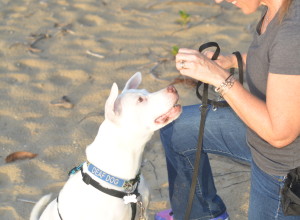
A hand target is also a nice foundation behavior upon which many other behaviors can be built–behaviors such as a weave or a spin which are incompatible with other less desirable behaviors. Too, with targeting you can teach your deaf dog to move onto a veterinarian’s scale or in/out of the car without any physical manipulation nor pulling/pushing.
You can teach your dog to relax and let you have their paw for nail trims or to learn a chin rest target to communicate when they are feeling calm enough for other grooming or veterinary procedures to continue. Both husbandry and fun behaviors can be trained from the hand target base.
A complement to starting out with your deaf dog, would be the pocket guide, A Deaf Dog Joins the Family. Using the techniques in this post will help to set you and your deaf dog up for success!






 The results were two solid thumbs up from George and Blanca (our deaf dog who leads with her nose!)! Both dogs were keen for more and even the cats took an
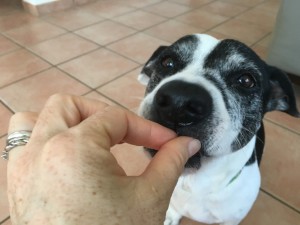 Total time from prep (really quick, grind Honest Kitchen in mini