Separation Anxiety in Dogs: Don’t Panic!
Don’t Panic! When it comes to helping dogs with separation anxiety there is relief.
Separation anxiety in dogs can be an extremely debilitating behavioral issue for both the animal and the pet parent. This year I’ll be presenting on the topic of separation anxiety in dogs at ClickerExpo and wanted to have a graphic available that I could hand out and that folks could download.
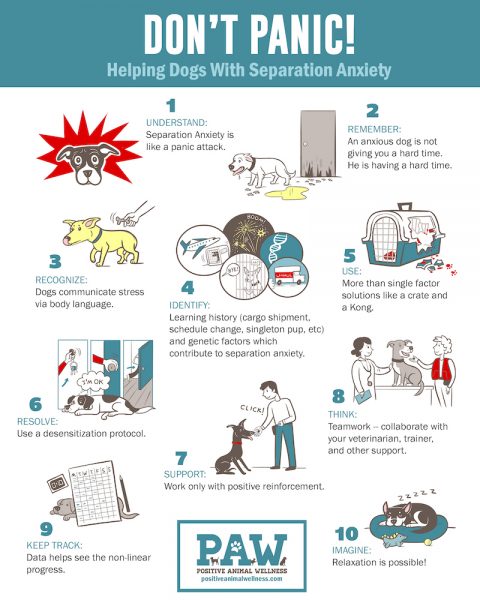
With an idea for the “Don’t Panic! Helping Dogs with Separation Anxiety” graphic in mind I reached out to world renowned artist Lily Chin. She was able to collaboratively help put my thoughts about the different aspects of the poster together into the format that is laid out in this post. (Note: If you would like to download a high resolution version of the “Don’t Panic! Helping Dogs with Separation Anxiety” poster, scroll to the bottom of this post.)
1. Understand: Separation anxiety in a dog is like a panic attack.

Separation anxiety in dogs is like a panic attack. A dog is not naughty and not misbehaving; he’s not being vengeful or trying to get back at you about something. When he displays the types of behavior generally associated with separation anxiety, they are rooted in fear, anxiety, and stress.
Separation anxiety is when the dog is feeling anxious and panicked at the fact that he is alone or without access to you. The resulting behaviors are often involuntary, much like if you were terrified about something and you started to shake. It’s not something that you’re doing on purpose. It’s something that is as a result of that underlying fear component.
2. Remember: An anxious dog is not giving you a hard time. He is having a hard time.
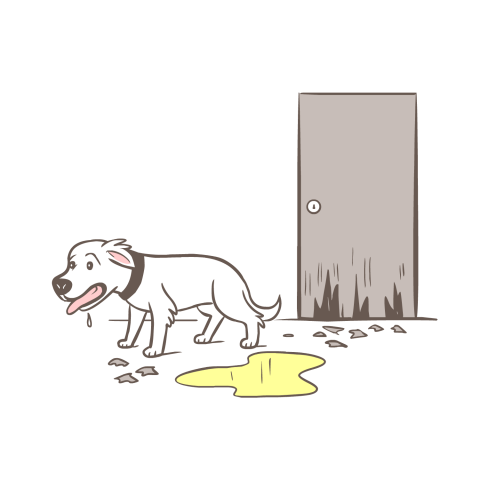
The above quote helps people to reframe what the dog is experiencing if the dog is behaving in a way that they don’t necessarily like. To clarify, there is no good behavior or bad behavior—behavior is just information and communication.
Therefore, if a dog is behaving in a manner we do not necessarily want to repeat, take a look at the reason for the behavior. If the behavior is occurring as a result of fear, anxiety, stress or a combination of those three issues, then these would be the underlying concerns. The anxiety would be the problem to address vs. the behavior the displays while “giving” you a hard time.
Approaching the issue from the perspective that the dog is the one having a hard time, enables us to be more compassionate about what’s going on. Then we can try to address it in a way that helps the dog versus thinking about punishment strategies, which of course I would never recommend. Thinking about the situation in terms of a dog not giving you a hard time, but having a hard time, helps us compassionately take a look at the overall approach.
3. Recognize: Dogs communicate stress via body language.
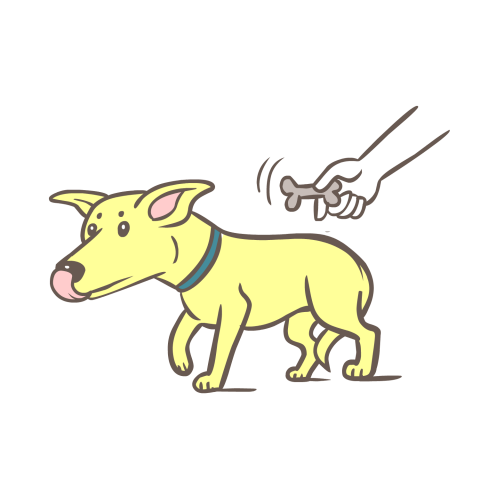
Dogs are great communicators but sometimes we find that people may not recognize what the dog is trying to convey. Examples of subtle versions of a dog communicating anxiety and stress might include the following. Anxiety can be conveyed via a behavior called “whale eye.” Whale eye is when the dog looks away, and we see him looking back with a lot of the whites of his eyes showing. Also, dogs might yawn, or do something out of context like panting heavily, when they haven’t been exercising. They might raise just one front paw, or a dog might look away or try to move away from you.
All of these more “subtle signs” of body language are indicative of the dog not feeling comfortable. We say subtler because when we take the behavior up a few notches, and the dog has to communicate more directly, that’s when we’re talking about things like a growl, an air snap, or a bite.
We never want to have a dog in a situation where he feels he has to raise his level of communication to those interactions before we understand that he’s trying to communicate his lack of comfort.
4. Identify: Learning the dog’s history (cargo shipments, schedule changes, singleton pup, etc.) and genetic factors which contribute to separation anxiety.
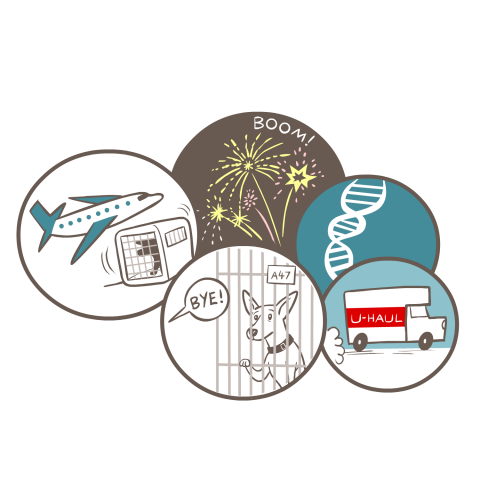
In this section we’re talking about looking at the possible contributing factors towards a dog suffering from separation anxiety. While there’s currently no one definitive cause, there are several aspects that might influence whether or not we see this type of anxiety in a dog.
As shown in the graphic, some of those circumstances include, a dog shipped via cargo while young. A change in the daily routine or schedule can be a catalyst, too. An example is if someone previously worked outside of the home begins working from home, and then goes back to working outside of the home.
Another issue might be a pup who raised without any siblings, or a singleton pup. There are also some genetic markers that are being looked at now. Often it’s a combination of nature and nurture, as with most behavioral issues.
5. Use More than the single factor solutions like the crate and a KONG.
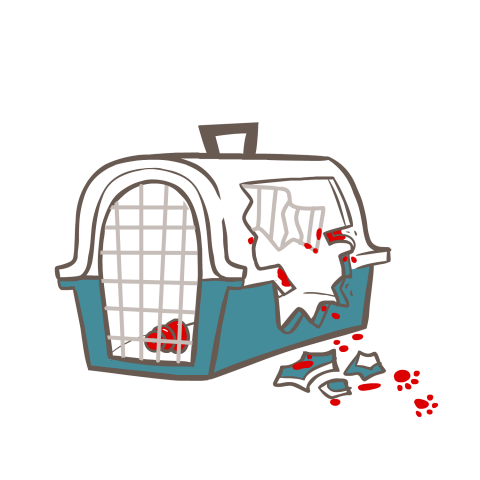
Both crates and KONG toys have a great place in behavior modification and training. Kongs are fantastic food puzzles for enrichment and they can help to provide mental stimulation. Crates, when of course trained positively, can be helpful for situations where the dog needs to relax, perhaps at the groomers or at a vet’s office, or even during transport.
However, when we’re observing separation anxiety in dogs, frequently a food puzzle or a crate doesn’t address the underlying issue–anxiety. As such, we want to use a more comprehensive approach where we try to help resolve the underlying stress.
6. Resolve: Use a desensitization protocol.
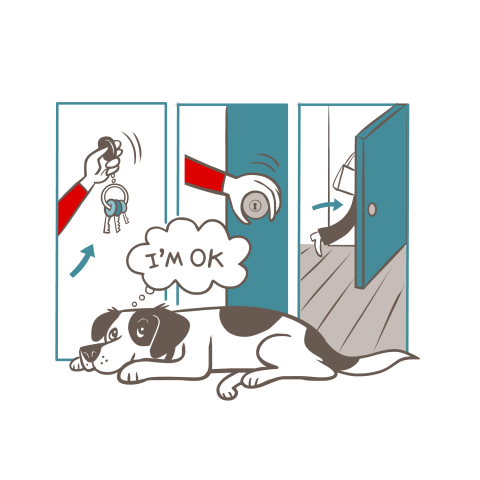
When talking about resolving separation anxiety in dogs, the way that we can get to a point where an animal feels more comfortable when alone is to use a specific protocol dedicated to desensitization. We occasionally pair some aspects with some counter conditioning as well.
What we’re looking to do is to enable the dog to feel comfortable at first with movements, and then with movements associated with departure. We call the types of cues associated with your leaving, “pre-departure cues.” Slowly, over time, we add in the pre-departure cues and expand the duration with the specific desensitization protocol so that we help the dog with separation anxiety to feel comfortable and confident when he’s alone.
7. Support: Work with only positive reinforcement.
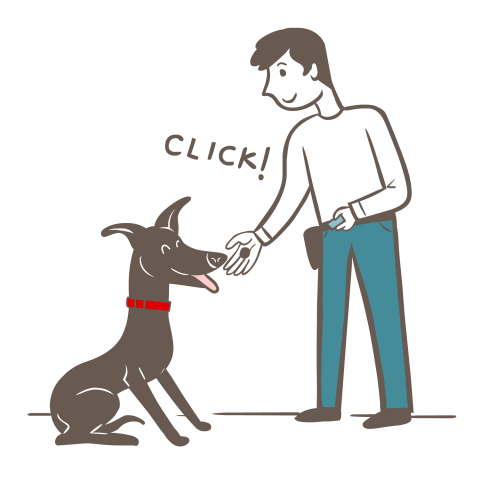
Working with positive reinforcement is the key to any behavior modification and training plan. Anytime we have a behavior we don’t want to see repeated, step one is to identify what is supporting the behavior. Specifically, we want to look at what is causing the behavior to be repeated and to continue to occur. Then we want to look at the underlying cause and see what we can do to change that behavior. We take this approach instead of trying to stop or decrease behavior which can have dangerous consequences.
Working with a qualified dog training professional and working with positive reinforcement will help the dog to build confidence. With positive reinforcement, we observe the behavior, and then we mark the behavior, and then finally we reinforce behaviors that we want to see happen with more frequency. Behaviors that are reinforced are repeated. Ultimately, we want to reinforce those behaviors that we’d like to see more of.
8. Think: Teamwork – collaborate with your veterinarian, trainer, and other support.
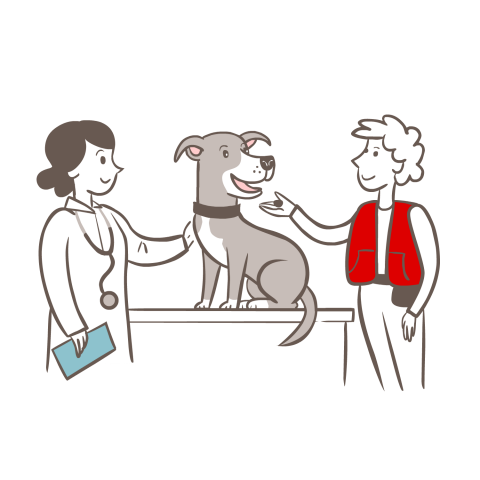
When working with a dog who may suffer from separation anxiety my first suggestion is that the family make an appointment with their veterinarian to rule out any potential medical reason for the unwanted behaviors that they are seeing.
During the veterinary appointment I also encourage them to have a comprehensive chat with their vet about what’s going on and the possibility of medications if the vet believes that meds would be appropriate. It is about a teamwork approach to resolving the issue—a teamwork approach between the pet parent, the veterinarian, and the trainer.
Sometimes we might involve other dog care professionals, such as a doggy daycare facility or a dog walker. The goal is for everybody to work together to help the dog ultimately feel more comfortable when he’s home alone.
9. Keep Track: Data helps you to see the nonlinear progress.
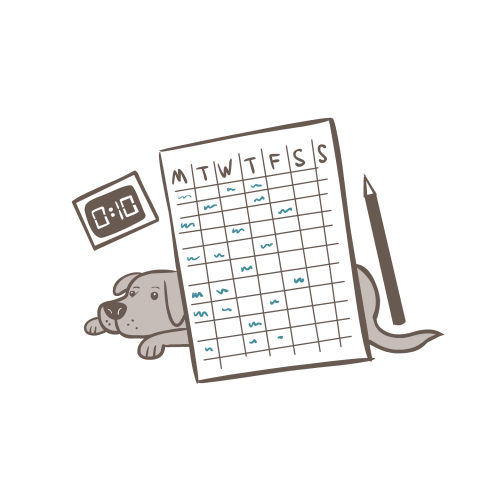
Sometimes people will toss out ideas for resolving issues. I always go back to a quote by Doctor Susan Friedman, which is, “Show me the data.” If we can show and demonstrate data, or better yet, scientific data, then we can look at whether or not this is valid information.
When working on separation anxiety in dogs, we’re often working with tiny criteria increases. As such, it’s beneficial to document what’s going on with the dog. It’s productive to document what we’re working on, to document the protocols, and to document any changes in the environment that might affect things.
For example, if a dog has had a lot of exercise at doggy daycare on one particular day, maybe the pup appears calmer on those days. Or, if one person in the house is away for a business trip, perhaps that’s a more difficult week for the dog. Maybe a family vacation where the dog is boarding equates to a particularly challenging week for the dog. All of those factors can play into our overall plan for helping the dog to feel more comfortable when alone. As such, data tracking is a critical point in our overall separation anxiety protocol.
10. Imagine: Relaxation is possible!
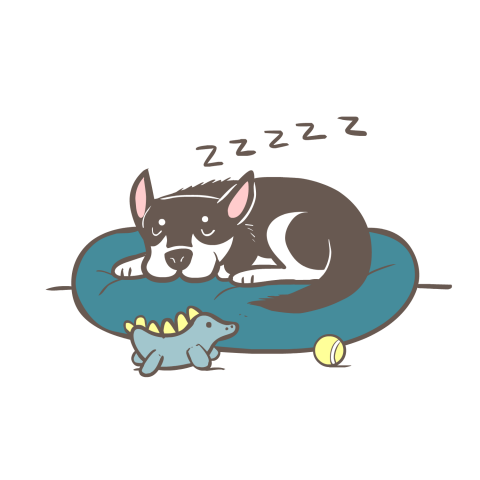
Having a relaxed and calm dog is most definitely possible. For example, I have clients who now can go out, stay out away for several hours, and leave their calm dog home alone.
The ability to have your dog comfortable while home alone is life-changing not only for the dog but for human families too. I had one mom who is now able to go grocery shopping–something that we probably take for granted. A dog staying home alone and feeling relaxed when previously he was howling, eliminating, and chewing things up in the house is possible.
I have several clients who now can go out and about their regular daily lives while their dogs are relaxed and nonchalant at home. At the end of my upcoming presentation at ClickerExpo, I’ll be sharing some of these success stories.
But just by way of a few examples, I have one mom who was able to go to a spin class, which entails her being gone from home for two and a half hours with the commuting time back and forth to the class. I worked with a dad who’s able to go out and work from a coffee shop. He works remotely, but this allows him much more flexibility. He can meet with clients during the day because he now has a dog that can relax calmly at home and no longer suffers from anxiety when he’s separated from his people.
If your dog currently suffers from separation anxiety, know that relaxation is possible!
Get relief from the desolation of your dog’s separation anxiety.
 Have you been thwarted by previous training attempts? You need a highly-trained specialist—an expert who devotes her days to resolving dog desolation distress.
I offer a distinctively successful approach to separation anxiety issues with daily guidance and extensive encouragement. If you and your dog are suffering from your dog’s separation anxiety, sign up for my Separation Anxiety Program. I’ll help dissolve your despair.
Schedule your first session today
**You can download the full sized separation anxiety graphic by clicking on the image below**