
puppies

June 3, 2016

Why the Where Matters: Marking & Reinforcing Behavior
Terrie Hayward
Marking and Reinforcing Behavior

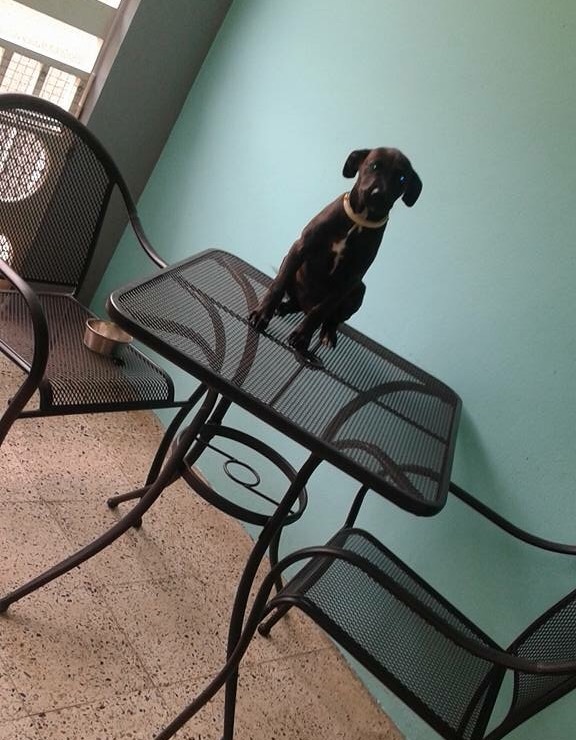
Marking and Reinforcing Behavior Photo credit: Lizbeth Santiago

When working with your dog and reinforcing behavior, the saying goes that we “mark” for behavior and “reinforce” for position. At the start this is often a new concept for clients.

An example of the usefulness of this behavior can be demonstrated as follows. The pup in the photo has jumped up on to the table to (reportedly) eat the cat food. Often we might see folks attempting to scold or physically remove the dog.

But, what does that teach the pup?

Instead, I suggest finding some behavior that we like (eye contact, orienting to name, collar grab) and then marking that behavior right where the dog is, but (key point here!) — tossing the reinforcer on to the floor!

You may need to repeat this process a few times. You also want to be sure that you are working with high value reinforcers, as you are competing with the “score” of finding the cat food on the table. However, eventually, that ever-growing pile of goodies (reinforcers) on the floor will become so tempting that the dog will jump down.

This is the point to mark again (yes! the dog now has four paws on the floor where you want them!) and reinforce. I suggest repeating this marking/reinforcing (click/treat if you like) over and over in quick succession several times in a row to strongly communicate that good things really DO happen on the floor and that the floor IS the spot to be!
June 1, 2016

Why I Taught My Foster Dog Targets & Spins

Terrie Hayward

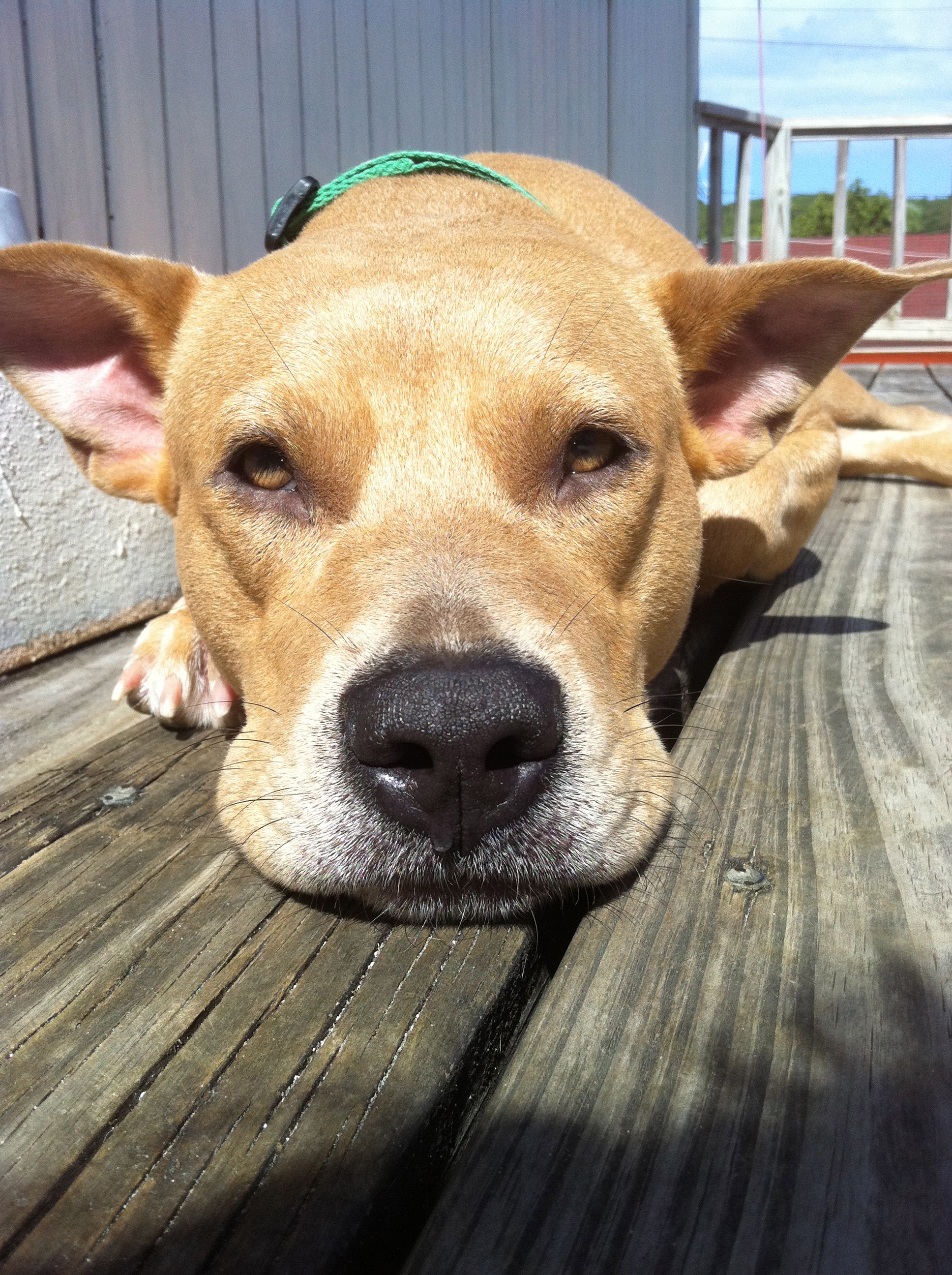
Canelo is a board & train foster pup who had been living with us at PAW for six weeks. He was rescued with a severe case of Demodex mange, dehydrated, starving, and very fearful of people.

We began his training by teaching him that he has choices. Choices as to whether he wanted to be closer to us, choices as to whether he wanted to “play” with us, and choices about moving away to a more “safe” feeling spot when and if he wanted to.

One of the first behaviors that we taught Canelo was that choosing to touch a target (both a hand target and a target stick were practiced) voluntarily resulted in good things-namely spray cheese at the start. Canelo slowly determined that it actually wasn’t so scary to decide to touch the target and we communicated that he’d earned access to something he found reinforcing by conditioning a marker (both a clicker and a verbal “yes”).

Target training is a great building block behavior. It is collaborative and voluntary and works on building confidence. Too, we can teach many other behaviors once this first step has been learned.

Soon, he was targeting and improving with his fluency and latency. We worked in lots of short sessions in order to begin to build a strong reinforcement history. Next, we taught Canelo that he could also choose to touch the target in a variety of positions and eventually from distances as well. Finally, Canelo learned to follow and touch a target that moved around.

Once Canelo began to follow a moving target we taught him to “spin.” Spin isn’t a behavior that I like to teach first as the first behaviors learned have the longest reinforcement history (more practice) and as such, are often default behaviors. Thus, I’d prefer a target or a sit to be one of the “go to” behaviors. With a “spin” we also don’t want to create a stereotypic behavior ( “repetitive, invariant behaviour pattern with no obvious goal or function”, http://www.awionline.org/lab_animals/biblio/at-phil.htm).

However, Canelo didn’t offer many sits and so we decided to teach another behavior which accomplished the same goals. The goals being that the behavior was able to be performed in a small space, performed on cue, and which would be an alternative or incompatible behavior to some less desirable ones (such as barking or jumping, for example).

So, to conclude, a couple of nice behaviors that Canelo now knows which he has in his “basket of behaviors” and can be cued and utilized for fun and training are targeting and spinning!

March 26, 2015

SEPARATION ANXIETY is so much more than a CRATE and a KONG!

Terrie Hayward

Dog Separation Anxiety

Living with a dog with Separation Anxiety can be overwhelmingly difficult. Folks may feel like prisoners in their own home and can have costly emotional and physical fallout from the situation.

Many times people are mistakenly given the advice to get the dog used to a crate with a stuffed Kong (or other food puzzle). But, there is so much more involved in successfully treating (yes, Separation Anxiety IS treatable!) this phobia.

Rather than just teaching a dog to “eat” alone, we need to help them to feel comfortable “being” by themselves.

Canine Separation Anxiety is a panic disorder. As such, although remedies and suggestions such as food puzzles, Thundershirts, and DAP collars may fall under the heading of “can’t hurt,” they also are unlikely to actually help with much progress when used alone.

Instead, we use a specific protocol designed to desensitize to absences in very small increments with many, many repetitions over time.

Frequently, folks may begin with a 5 minute absence believing that this is an extremely brief duration. However, depending on the dog, first steps may need to be broken down into being in sight, but further away in the same room to start out.

Departure cues are included and criteria is raised and temporarily lowered as duration and other elements are introduced. Things like keys and shoes and cars starting will all come with time and are built into the micro departure steps with thought and care given to the overall plan. Managing each component of the plan daily is key.

The process requires a great amount of patience and consistency-the backbones of permanent, lasting behavioral change.

With the right guidance, attitude, commitment, and perseverance you can see seconds turn into minutes and minutes become longer and longer absences until eventually your dog learns to trust in the feeling that it is ok for them to be home alone.

For help or questions with possible canine Separation Anxiety, you can contact PAW today. http://positiveanimalwellness.com/contact/

Ready for better dog or puppy behavior?

Fetch the latest training intel–straight to your inbox!