If you’re living with a dog who suffers from separation anxiety, you already know how emotionally exhausting and disruptive it can be. The pacing, vocalizing, destruction, and panic behaviors aren’t signs of stubbornness or disobedience—they’re signs of genuine distress.
As a professional dog trainer and behavior consultant who specializes in separation anxiety, I want to be very clear: there are fixes that work. But they don’t come from quick tips, rigid timelines, or one-size-fits-all solutions. Real progress comes from understanding why separation anxiety happens and using evidence-based strategies that support the dog as an individual.
1. Patience and Consistency Are the Foundation
This is often the hardest truth for people to hear, but it’s also the most important: there are no quick fixes for dogs who suffer separation anxiety–or for any behavior issues. Every dog learns at a different pace. Some may make progress in weeks, while others need months or longer.
Think of it like learning a new skill. Two people can start at the same time with the same instruction and still progress very differently. That doesn’t mean the process isn’t working—it means the learner is an individual. Consistency and patience are what allow learning to happen safely.
2. Vet Support + Behavior Modification Works Best
For many dogs with separation anxiety, the most effective approach combines behavior modification with veterinary support, which may include medication. Medication doesn’t “solve” separation anxiety, but it can reduce the intensity of fear and panic so that learning is actually possible.
When anxiety is lowered, dogs are able to experience calm absences rather than repeated panic episodes. This allows us to build a strong reinforcement history of relaxed behavior instead of rehearsing fear responses over and over again.
3. Desensitization Must Follow the Dog’s Pace
A well-designed desensitization protocol is one of the most effective tools we have. Desensitization means gradually exposing a dog to being alone at a pace they can tolerate comfortably.
The key is reading the dog’s body language. Subtle signs of stress tell us whether we should stay where we are, move forward, or take a step back. Progress is rarely linear. There will be good days and frustrating days—and that’s normal.
What matters is the overall trend. If the trajectory is positive, even with bumps along the way, the protocol is working.
4. Small Approximations Prevent Setbacks
One of the most common mistakes people make is jumping too far ahead—leaving for five or ten minutes when the dog isn’t ready. That’s often flooding, not desensitization.
Instead, we work in very small approximations, especially at the beginning. Sometimes that means seconds. Those early steps can feel slow and discouraging, but over time they compound. Seconds become minutes. Minutes become longer absences. Progress builds naturally when the foundation is solid. We also vary our durations so that the trajectory isn’t always “something harder.” This helps to build confidence in you and in the process.
5. Set the Dog Up for Success
Training should happen when the dog’s basic needs are met. That means they’ve eaten, gone outside with a bathroom opportunity, had appropriate enrichment and exercise, and aren’t dealing with additional stressors. Trying to work on separation anxiety when everyone is already overwhelmed makes learning much harder.
6. Build Confidence Outside the Protocol
Positive reinforcement training that’s adjacent to the separation anxiety work—like teaching a dog to settle on a mat or to target—can help build overall confidence and strengthen the human-dog relationship. While separation anxiety requires its own specific plan, confidence-building behaviors support emotional resilience.
7. Track Data and Set Realistic Expectations
Progress with separation anxiety often includes plateaus and occasional regressions. Tracking training helps us identify patterns and make informed adjustments. This is a long-term process, and that’s okay.
Working with qualified professionals—a veterinarian, a veterinary behaviorist, and a positive reinforcement trainer—can make an enormous difference in navigating the process successfully.
Helping a dog with separation anxiety isn’t about perfection. It’s about helping them feel safe, relaxed, and capable when they’re alone—and that is achievable with the right support.
Separation anxiety in dogs is one of the most misunderstood behavior issues—and unfortunately, that misunderstanding often leads to guilt, blame, and ineffective advice. If you’ve ever been told that you caused your dog’s separation anxiety by cuddling too much, sleeping together, or greeting them wrong, this article is for you.
I am a professional dog trainer and behavior consultant specializing in separation anxiety. In this post, we’re breaking down what separation anxiety is NOT, clearing up some common myths, and helping you understand what’s really going on with your dog.
Separation Anxiety Is Not Boredom
One of the most common misconceptions is that a dog who destroys the house or vocalizes when left alone is simply bored.
While boredom can lead to nuisance behaviors, true separation anxiety is an emotional panic response, not a lack of enrichment. Dogs with separation anxiety aren’t misbehaving—they’re distressed. Increasing toys or exercise alone will not resolve anxiety-driven behavior.
It’s Not Caused by Poor Socialization (Alone)
Socialization happens during a critical developmental window, roughly up to 12–14 weeks of age, when puppies form positive associations with the world. A lack of socialization can absolutely contribute to behavioral challenges later in life.
However, poor socialization does not equal separation anxiety.
Even dogs that missed that early window can learn new, positive associations later on. While under-socialization may create generalized fear or reactivity, it is not a definitive cause of separation anxiety.
A “Bad Fit” Is Not Separation Anxiety
Sometimes behavior problems are mislabeled as separation anxiety when the real issue is a lifestyle mismatch.
For example, a highly active family paired with a low-energy dog—or vice versa—may struggle to meet everyone’s needs. That mismatch can result in frustration or stress, but it is not the same as separation anxiety, which is specifically tied to being alone or separated from a particular person.
Letting Your Dog Sleep in Your Bed Does NOT Cause Separation Anxiety
This is one of the most persistent myths—and it’s completely false.
There is no scientific evidence showing that allowing your dog to sleep in your bed causes separation anxiety. As long as both you and your dog are sleeping comfortably and it’s not creating issues, co-sleeping is not harmful.
You are not creating anxiety by being affectionate.
Greeting (or Not Greeting) Your Dog Does Not Cause Separation Anxiety
Another common belief is that enthusiastic greetings—or ignoring your dog entirely when you return home—cause separation anxiety.
They don’t.
While trainers may recommend low-key arrivals and departures as part of a management strategy for dogs already struggling, these behaviors do not create separation anxiety in the first place.
You Didn’t “Spoil” Your Dog
Caring for your dog does not cause anxiety.
Affection, comfort, and responsiveness do not spoil dogs or make them emotionally weak. What can happen is unclear communication—something that can be improved through positive reinforcement training.
Training is education. Every interaction teaches something. But love is never the problem.
A Lack of Training Did Not Cause Separation Anxiety
Similarly, not having perfect training does not cause separation anxiety.
You may unintentionally reinforce behaviors you don’t want, but you didn’t create your dog’s panic disorder. Separation anxiety is not a training failure.
So… What Does Cause Separation Anxiety?
Here’s the truth: there is no single definitive cause.
Separation anxiety appears to be the result of nature plus nurture, often involving a genetic predisposition combined with environmental factors. Potential contributors include:
Use of aversive training methods
Being a singleton puppy
Early traumatic experiences (such as traveling in cargo at a young age)
Major routine changes
A clear example emerged after COVID, when many dogs grew up with constant human presence. For dogs already predisposed, that environment may have “flipped the switch”—but it did not cause the condition on its own.
The Most Important Thing to Know: It’s Not Your Fault
If your dog has separation anxiety, you did not cause it.
But help is available.
Effective treatment often includes:
Ruling out medical issues with your veterinarian
Considering medication when appropriate
Working with a qualified professional who uses positive reinforcement
Following a structured, evidence-based behavior modification protocol
Separation anxiety is treatable, and your dog can learn to feel safe and relaxed when alone.
In the next article in this series, we’ll cover common “fixes” that don’t work—and why.
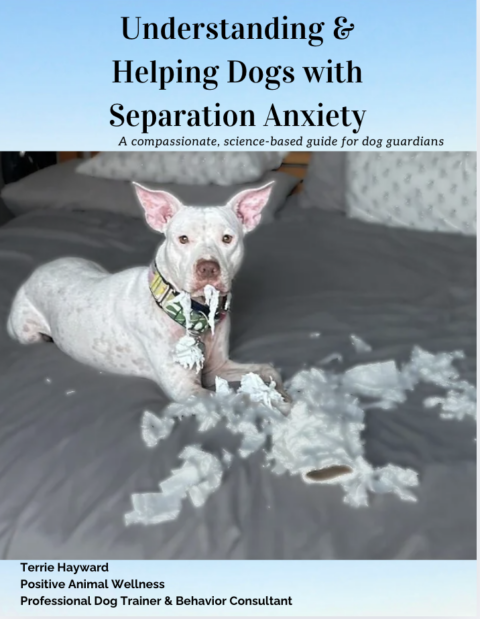
Download the free ebook and start understanding your dog’s distress—so you can help them, not fight them.
Quick Answer: Is It Really Dog Separation Anxiety?
Dog separation anxiety is an umbrella term often used to describe significant distress related to being separated from a person or being left alone. But not every dog who barks, destroys things, paces, or escapes when alone has true separation anxiety.
Similar-looking behaviors can also result from isolation distress, barrier frustration, confinement distress, boredom, normal developmental behavior, or medical problems.
The most important first step is therefore not simply asking, “How do I stop my dog from destroying things?”
It is asking:
“What is my dog actually experiencing when I leave?”
That distinction matters because different causes of distress require different approaches.
How to Understand What Your Dog Is Telling You When You Leave
If your dog panics, vocalizes, destroys things, or shuts down when you’re gone, you’ve probably been told they have dog separation anxiety.
But here’s what I want you to know right away: Dog separation anxiety is not one single condition.
In my work, I see far too many well-meaning guardians trying to “fix” the problem without truly understanding why their dog is distressed. And when we misidentify the cause, even the best training plans fail.
Before we talk about solutions, we need to talk about what dog separation anxiety really means—and what it doesn’t.
Watch the Video:
Dog Separation Anxiety Is an Umbrella Term
Most people use dog separation anxiety to describe any unwanted behavior that happens when their dog is left alone. Barking, chewing, escaping, pacing—it all gets lumped together.
From a behavior perspective, that’s a problem.
Dog separation anxiety is actually an umbrella term that includes several different types of alone-time distress. Each one looks similar on the surface, but each requires a very different approach.
Every dog is a study of one–meaning they are unique in their genetics and environment and learning history. If we don’t identify what’s happening underneath the behavior, we’re guessing—and guessing creates stress for both you and your dog.
Separation Anxiety vs. Isolation Distress: A Critical Difference
This is an important distinction in modern dog behavior science.
Clinical Dog Separation Anxiety
True clinical separation anxiety happens when a dog is attached to one specific person. When that person leaves, the dog experiences panic—even if other people or pets are still present.
These dogs:
Follow one person constantly
Panic the moment that person leaves
Do not improve with daycare, sitters, or another dog
This is a panic disorder, not a training or obedience issue.
Isolation Distress (Far More Common)
Isolation distress is often mislabeled as separation anxiety.
These dogs don’t need you specifically. They just need a human presence. They’re fine with a sitter, another family member, or at daycare. They may be less comfortable with a select group of humans, but can still cope—but still also struggle when left completely alone.
Why this matters: Isolation distress can often, in part, be managed with environmental and routine changes. However, both isolation distress and separation anxiety both require a structured, gradual behavior modification plan to get to relaxation.
Is It Really Anxiety—or Barrier Frustration?
Sometimes the behavior looks dramatic, but fear isn’t the driver.
Barrier Frustration (or FOMO)
Barrier frustration happens when a dog is upset about being blocked from access, not terrified of being alone.
Common signs include:
Destruction focused on crates, doors, or gates
High arousal rather than shutdown panic
Intense frustration about missing out
Treating barrier frustration as dog separation anxiety is likely unnecessary and instead requires a different training plan.
Rule Out These Issues Before Labeling Dog Separation Anxiety
Before considering a determination of dog separation anxiety, it’s important to rule out three things:
Age-Related Behavior
Puppies chew. Adolescents test limits. Not all destruction equals anxiety.
Boredom or Under-Stimulation
A bored dog will find their own job—and it’s rarely one you approve of. Boredom-based behavior looks different than panic-based behavior and needs a different solution.
Medical Causes
Pain, digestive discomfort, hormonal changes, and neurological issues can all mimic anxiety. A veterinary check is always step one.
Dogs React to “Context Cues,” Not Just Your Exit
Separation anxiety in dogs doesn’t start when you close the door. It often starts long before you leave.
Dogs are experts at pattern recognition. They notice the difference between:
Weekend shoes vs. work shoes
Casual movement vs. structured routines
“We’re staying” energy vs. “I’m leaving” energy
For dogs with separation anxiety (used as an “umbrella” term), stress hormones rise before you even grab the keys. That anticipatory stress is part of the reason why quick fixes don’t work.
Three Things You Can Do Right Now
Drop the labels. Your dog isn’t stubborn, manipulative, or spiteful. Focus on observable behavior—pacing, panting, vocalizing, freezing, escape attempts.
Work with a specialist. Separation anxiety is a niche within a niche. You need someone who understands panic disorders and appropriate behavior modification plans–not just basic training.
Include your veterinarian. Behavioral health is physical health. Reducing panic—sometimes medically—is often what makes learning possible.
Get My Free Guide to Dog Separation Anxiety
If leaving your dog feels overwhelming—or you feel guilty every time you walk out the door—you are not alone.
I’ve created a free guide to dog separation anxiety to help guardians understand what may be happening and what to consider before jumping into a training plan.
Inside, you’ll learn more about:
The different types of separation-related distress
Why dogs may panic when left alone
Why common advice doesn’t work for every dog
What to look for when evaluating your dog’s behavior
How to begin thinking about a more appropriate path forward
Download the free guide and start understanding your dog’s distress—so you can help them, rather than fight them.
Frequently Asked Questions About Dog Separation Anxiety
How do I know if my dog has separation anxiety?
Look for behavior that occurs specifically around separation, such as pacing, panting, vocalizing, escape attempts, destruction, or inability to settle. However, these behaviors alone do not prove separation anxiety. A professional assessment can help distinguish separation anxiety from isolation distress, barrier frustration, confinement distress, medical problems, and other causes.
What is the difference between separation anxiety and isolation distress?
Separation anxiety is generally associated with distress when a particular person or attachment figure leaves. Isolation distress occurs when a dog struggles primarily with being completely alone. A dog with isolation distress may be comfortable when a trusted person remains with them.
Can a dog have separation anxiety and isolation distress?
Yes. Dogs can have overlapping behavioral issues, which is another reason it is important to look at the individual dog’s behavior rather than relying on a single label.
Is destroying things always a sign of dog separation anxiety?
No. Destruction can have many causes, including anxiety, frustration, boredom, normal developmental behavior, confinement distress, or other factors. The location, timing, pattern, and emotional state accompanying the destruction provide important clues.
Should I crate my dog if they have separation anxiety?
Not necessarily. Some dogs are comfortable in crates, while others experience significant confinement distress. A crate should not be assumed to solve separation anxiety, and forcing an already distressed dog into confinement can make the situation worse.
Can dog separation anxiety be treated?
Yes. Separation-related problems can be addressed with appropriate behavior modification and management. The specific approach depends on what is driving the dog’s distress, how severe it is, and the individual dog’s needs. Veterinary involvement may also be appropriate.
Should I let my dog “cry it out” when I leave?
If your dog is experiencing significant panic or distress, repeatedly exposing them to overwhelming absences is not a good substitute for a carefully designed behavior-modification plan. The goal should be to teach the dog that being alone can be safe and manageable, not simply to wait for the dog to stop reacting.
When should I get professional help for dog separation anxiety?
Consider professional help if your dog panics when you leave, attempts to escape, injures themselves, destroys doors or windows, cannot settle, or if the problem is significantly affecting your household. The sooner the underlying problem is accurately identified, the sooner you can begin an appropriate plan.
About Terrie Hayward, CSAT, CDBC, KPA-CTP
Terrie Hayward is a Certified Separation Anxiety Specialist (CSAT), Certified Dog Behavior Consultant (CDBC), and Karen Pryor Academy Certified Training Partner (KPA-CTP) and Faculty member. She is the founder of PAW – Positive Animal Wellness and specializes in separation anxiety and positive reinforcement behavior modification.
Her work focuses on helping dogs experiencing separation-related distress through individualized, science-based behavior modification and recovery strategies.