
May 13, 2013

Training All Around Town

Terrie Hayward

httpv://www.youtube.com/watch?v=p5vaPjXkTr4

Tulip was rescued about one week ago. She has already been practicing hand targeting and has now begun to grasp the cue for the behavior “lie down.” One thing you should remember with training is that it takes consistency and repetition.

Tulip learned to lie down with a cue in the kitchen, but that didn’t mean that she could do it automatically on the porch. Cues must be practiced in different locations-preferably beginning with a quiet spot without distractions. Then, slowly, you will want to practice behaviors in new places and eventually while adding distractions-again starting from minor and moving to bigger things that might catch your dog’s eye/nose.

You should practice all around your area and in as many locations (indoor and outside) as possible. You should also gradually add new distracting elements to your environment and repeat short practice sessions often. When it comes to your dog listening to the cue that you give for “sit” instead of chasing a squirrel or a chicken (in our case) if you have practiced many places and with many things going on and many, many times, you should have built up a good “bank” of reinforcements that will help your dog to make the correct decision.
May 10, 2013

Yes! Why “no” holds no value.

Terrie Hayward
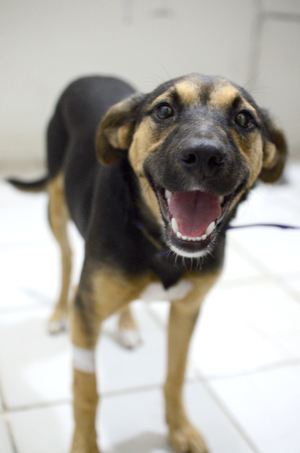
Luna is available for adoption through ARF www.arfrincon.com Photo curtesy of Lauren McLaughlin photography.

Luna is available for adoption through ARF www.arfrincon.com
Photo curtesy of Lauren McLaughlin photography www.photographyLAM.com.

Often folks are encouraged to let dogs know that they are displeased or prefer that they don’t continue with certain behaviors by saying the word, “no.” The word, “no,” however is one that you might consider eliminating from your vocabulary with your pup.

“No” doesn’t tell the dog what exactly we don’t want him to do. It doesn’t let her know what we would like her to do. And, bonus, saying “no” actually acts as a reinforcer for the dog. When you say, “no” you are paying attention to your dog, you are speaking to your dog, and often the word is exclaimed with great enthusiasm which may seem exciting to your dog as well.

Instead, consider ignoring a behavior that you prefer not to see repeated. Without reinforcement, research shows that the behavior will extinguish. Furthermore, you can teach and put on cue an incompatible behavior as just as you can’t be in two places at once, you can’t do two opposing things at the same time (think sit & jump up).

Finally, catch your dog doing something right and praise and reward. After all, if you change your vocabulary to include more of the word, “yes” you will find you have a happier, healthier relationship with your pet.

PAW can help you get started on these changes today!


May 4, 2013

Positive Training and Impulse Control

Terrie Hayward

httpv://www.youtube.com/watch?v=3xBe6BLg5zI

Would you like your dog not to scavenge all types of disgusting (and sometimes dangerous) things from the ground? Impulse control can be taught quickly and easily with positive reinforcement. There is no need to  reprimand a dog, but rather you can teach your pup that good things happen when he makes the correct choice.

In this case, George is choosing to wait until he is given the food/treats. He knows that if he makes the decision to hold off and not try to scoff up the bits on the ground-or even the piece on his paw-that he can have them!  By making a good choice he gets what he wants-in this case a very desirable bit of hot dog!

If you would like your dog to behave with such nice “table” manners contact PAW-Positive Animal Wellness today!

Ready for better dog or puppy behavior?

Fetch the latest training intel–straight to your inbox!