clicker training

April 1, 2019

Cues: Upgrading Your Dog’s Response
Terrie Hayward

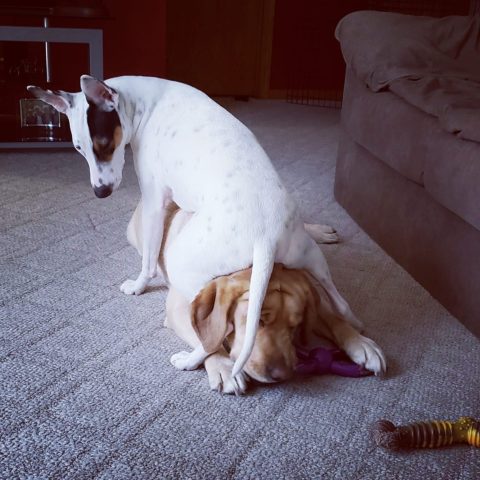
photo credit Ashley Szews

Repeatedly cueing the behavior when your dog does not respond does not improve the efficiency of cues. 

“Come! Come! Come!” or the equivalent visual version of repeating the cue over and over actually serves to potentially weaken your cue and subsequently your dog’s reliable and rapid response.

If you cue a behavior and your dog does not react appropriately, do not cue it again. Instead, cue an easy alternative. For example, cue a behavior that your dog has a 99% chance of effectively performing—possibly a name recall, eye contact, collar grab, or a hand target. Then, stop your training session. Finish with this successful behavioral response and take a break while you consider what went amiss. 

If your dog was highly motivated by the reinforcer you were offering, had sufficiently practiced at the level of difficulty where you were working, and understood the cue you were communicating there would be no reason that she would not successfully comply. For this reason if you are struggling with your dog’s response to a cue, you might want to dissect the problem.

The first step is to always rule out any possible medical reason for behavior. Be certain that your dog is not experiencing any medical issues that might prevent her from being able to respond to the cue.

Having then ruled out any possible medical difficulties your next avenue is to address the behavior. It’s likely that the cue response problem lies with one of the following issues. 

          1. The reinforcer is not strong enough.
          2. The environment is too distracting. 
          3. The dog does not understand the cue. 
          4. A combination of the above scenarios. 

Reinforcer

First, double check that the reinforcer that you have chosen is a “200” on a scale of 1 to 10 for your dog. In other words, does she really want to work for what you are offering? Your dog will demonstrate her preference via her response time and interest level. Think about how it might look different if you are offereing a piece of kibble vs. a piece of chicken.

Environment

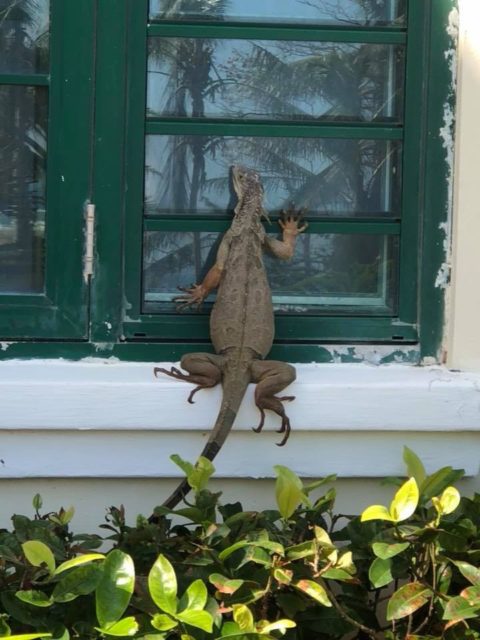
Also, consider whether there might be environmental reinforcers that could simultaneously be competing at a stronger level. For example, in Blanca’s world chasing iguanas would trump cheese any day. Are there any other distractions going on in your training venue? Is this the first time working in this spot? Acknowledging the level of difficulty based on the distractions, which would include training in a novel environment, is a key part of training decisions.

Cues

Finally, think about your training plan. Have you sufficiently trained the cue for the behavior in the environment that you are asking for it to be performed? Did you build a strong foundation and a long reinforcement history with the cue? Did you start, first with shorter distances, lower distraction levels, and less duration? Did you then work towards increasingly more difficult versions and is your dog able to respond immediately and quickly to the cue each time? In other words is your cue under stimulus control?

Taking steps backwards and breaking down the over-all criteria for your behavior can enable you to gain gain traction and make progress. Split your criteria into small steps and celebrate (reinforce) the tiny approximations.
Let’s use a recall behavior as an example. Beginning right next to your dog is the key. Often working indoors where you can
control the environment and the level of distractions can help to get things started. Using higher level reinforcers as you increase your difficulty criteria  is an important consideration. For instance, when taking the training “on the road” or upping the distance you are working at you want to use those top level reinforcer options.

Be sure that your cue is clear and consistent and confirm that you have an effective marker in place which you predictably pair with a reinforcer every time. 

We are continuing to practice my dog Blanca’s recall and recently have begun working with more distance in the fenced tennis courts. However, we still have work to do should an iguana decide to appear ;)!
February 28, 2019

Deaf Dogs and Cats: Chase to Calm

Terrie Hayward

Does your Deaf Dog like to chase your cat? Can you safely change this interaction? Often people end up with advice which might make the situation worse. Here is a training solution which works!

MANAGE:

Step one is to set everyone up for safety and success. This means that you want to employ management procedures to avoid your deaf dogs practicing this unwanted behavior. Using crates (if your dog voluntarily will go into his crate), baby gates, and/or tethering him to you with a leash are easy ways to avoid continued rehearsals of the behavior that you don’t want to see continue. 

PAIR:

Step two is to pair the sight of the cat with something positive. This way your dog begins to associate your cat with good things. There are two key points to this step. The first is to be sure that you give your dog a treat before he reacts to the cat. That is, when he first sees the cat, but before he begins to vocalize or pull (*key) pop a high value, soft treat in his mouth. This way the sight of the cat starts to equate to a yummy treat. 

The second key point is that you want to be sure that your deaf dog sees the cat before you give him the treat. The order is important as you want “scary cat” to equal yummy treat…not the other way around. Eventually when your dog sees a cat, the cat predicts a treat. Now your deaf dog will begin to look forward to a cat appearing.

REINFORCE:

The final step is when you mark and reinforce an alternative response to the cat. Instead of seeing the cat and beginning to bark, jump, howl, or chase instead you want your deaf dog to see the cat and turn to you! This behavior of orienting to you instead of the less desirable response is what you will reinforce.

It looks like this: deaf dog sees cat and turns to look at you. You mark and reinforce with a high value, tiny, soft treat. Your dog has now just learned that orienting towards you is much more worthwhile than bothering with the cat. Over time this new response to the cat should become your dog’s default behavior. 

With this in mind, work on consistently building this new skill set. Remember to:

  • Manage the environment to set everyone up for success
  • Pair calm cat interactions with high value treats
  • Reinforce alternative behaviors you want to see repeated

Soon your deaf dog and cat reactions will be relaxed and mellow and allow for peaceful co-existace in your home!

If you’d like more help, please contact Positive Animal Wellness for one on one assistance.

January 30, 2019

My Deaf Dog Looks Away and Doesn’t “Listen”

Terrie Hayward

Does your deaf dog look away, look at you out of the corner of his eye, turn his head in the other direction, or move so he can’t see you when you are giving him a cue? 

Often people say that their deaf dog demonstrates these behaviors when he “doesn’t want to listen.” However in reality, the above described behaviors are known as “appeasement” signals. This is your deaf dog telling you that he is anxious or uncomfortable—probably due to feeling confused or conflicted.

Training equals education and communication and the basis is motivation and communication. Therefore, if your deaf dog appears not to “listen” either the motivation to perform the behavior you have cued isn’t there, he doesn’t understand the cue, or it’s a combination of both scenarios. 

Too, when training you want to keep in mind the three “Ds”: distance, duration, and distraction. For example your dog may be able to respond to the cue for “sit” at home, however might look away when you cue this behavior at the veterinarian’s office. This could be because while your dog understands the cue for sit he has not sufficiently practiced it with this level of distraction or difficulty as yet. 

PRO TIPS: To “proof” your cues and encourage more appropriate responses keep the following in mind:

      1. Practice, practice, practice your cues in a low distraction environment, close to your deaf dog first. 
      2. When teaching new cues remember to “label” using your visual (or tactile cues) them as they are happening so that your deaf can make the association between the behavior and the cue.
      3. Be sure that you have a consistent marker system so that you can communicate effectively with your dog when he’s done something that you would like to see more of!
      4. Carry high value reinforcers with you so that after you mark the sought after behavior you can reinforce it—so that it is more likely to be repeated in the future. 
      5. When building new behaviors be certain to mark and reinforce every correct response to the cue.
      6. If your dog does not respond appropriately, take steps backwards to make it easier for your deaf dog to be successful!

Need more help! Contact PAW today! 

Ready for better dog or puppy behavior?

Fetch the latest training intel–straight to your inbox!