
Deaf Dogs Barking: What to do?
Barking is one method of communication for dogs.
When barking becomes problematic because it is excessive the first step is to find out why the dog is barking. Is the barking due to anxiety, pain, confusion, or frustration? Has the barking inadvertently been reinforced?
In order for behavior to continue, there must be a maintaining reinforcing component. This is the science behind behavior. Behaviors that are reinforced are repeated. The reinforcement may be intrinsic or external. However, again, the first step is to discover why the barking is occurring and the next is to determine what the maintaining reinforcer is.
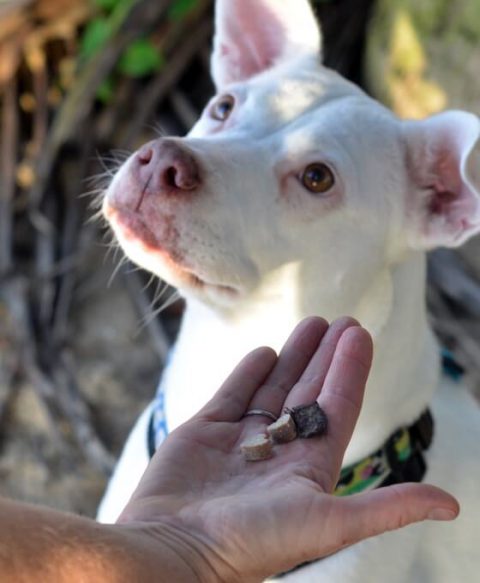
Anxiety:
Once cause of barking is anxiety. A specific type of anxiety which may be present is separation anxiety. In this case we would want verify when the barking is taking place. Is your deaf dog only barking when alone or when they don’t have access to you? Is the barking consistent and/or with excessive duration? Can you watch remotely or film your dog to see if the barking continues while you are away and/or if it might be combined with other behaviors indicative of separation anxiety such as: elimination, destruction, panting, pacing, or attempts to escape. If you question separation anxiety, crates, food puzzles, DAP other hormone/natural oils, etc. generally will not resolve the anxiety. Too, options such as crating may further exacerbate the issue by 1. not addressing the underlying problem of anxiety and 2. creating or encouraging new issues related to confinement which are frequently present with separation anxiety.
Pain/discomfort:
Pain or discomfort may be another underlying cause of incessant barking. The dog may be communicating that they are uncomfortable or feeling unwell. A through veterinary check is always the first line of defense to rule out any medical cause for behavioral issues. The dog may also be communicating the they are uncomfortable with a certain situation. For example, most dogs (http://doggonesafe.blogspot.com/2010/12/dogs-dont-like-hugs-and-kisses.html) are not entirely relaxed in the presence of hugging and kissing with humans. Some dogs might tolerate this type of interaction in a certain context-when in a comfortable venue with a person they trust and have a good relationship with. However other dogs may attempt to communicate their lack of comfort with certain behaviors via vocalization.
Frustration:
Another common source of barking is frustration. If a dog is confused or frustrated they may bark. For example, a dog might be trying to understand what we are asking from them but our timing could be off or unclear which could result in barking. Too, if this becomes a pattern of frustration the dog may bark more and more.
Inadvertent reinforcement:
The other reason for barking may come from unknowingly and/or unwillingly reinforcing this unwanted behavior. Let’s say that your deaf dog brings you a ball and begins to bark. In order to expedite them being quiet you toss the ball. You have a high probability that the dog has now connected the barking with the reinforcement gained from you throwing them the ball. Therefore, they will continue to bark to encourage you to throw the ball.
As such, be sure to have a look at the human’s behavior. Even interactions such as pushing a dog away or signing “no” (neither is encouraged: http://positiveanimalwellness.com/why-ive-never-taught-my-deaf-dog-the-sign-for-no/) can inadvertently reinforce attention seeking behavior. People may not view these types of interactions as reinforcing, however your deaf dog just may!
Final thoughts before you start your training:
To figure out how to “stop” your dog from barking you first need to figure out the reason for the barking. Then, you need to find out what is reinforcing this behavior. A final piece would be to teach or train an incompatible or alternative behavior (instead of the barking) which is equally (or more) reinforcing to your deaf dog and then cue and mark and reinforce this new behavior in order to start a different pattern.
Ideas for alternative behaviors to barking include:
- teach your dog to go to mat
- train your dog to get a toy and hold in mouth
- teach a hand target behavior
- train the impulse control in the hand or on the ground game
Let’s break this down a bit.
MAT: To begin, when your dog looks at his/her mat, mark and reinforce. Then once they are on the mat with two paws repeat. Gradually work on raising your criteria until you have four paws on the mat. Eventually increase your criteria to laying down on the mat. At this stage, you will want to have a rapid rate of reinforcement (mark/reinforce) several times in a row quickly to “cement” that this behavior is really worthwhile! The final step is to add a cue. As your dog is going to the mat and begins to lie down add your visual cue. Over time you will back the cue out in front of the behavior so that you are able to ask for it (“cue the behavior”). This way, instead of barking you can cue “go to mat and settle quietly” as an incompatible behavior.

Originally posted on DDR
TOY: Step one is again, marking and reinforcing interest in the toy. Hold the toy in your hand. If your dog doesn’t put their mouth on it help to make the toy more interesting. For example, hold hot dogs in your hand and then handle the rope bone. Once your dog puts their mouth on the toy immediately mark and reinforce. Repeat this many times via several sessions. Next, work on building duration so that you don’t mark right when your dog has the toy in their mouth, but after a second or two. Vary your duration so that it is not increasingly more difficult each time or you may find your dog getting frustrated. Mark for a longer duration and then mark for a shorter one, thus ensuring successful outcomes. Finally, add the visual cue as your dog holds the toy in their mouth. Just as with the previous behavior you will eventually begin cueing the behavior earlier and earlier until you can cue it before your dog picks up the toy. Thus, you now have another incompatible behavior (to barking) that you can cue and reinforce!
TARGET: Holding a treat in your closed fist, place your fist just an inch from your dog’s nose. The second they touch your fist with their nose use your other hand to give your visual marker and then open your fist and let your dog get the treat. Repeat. Continue repeating and eventually do the same series without a treat in your hand. Once you get the nose touch and mark with your visual marker, then go and get a treat to reinforce the behavior. The presentation of your target hand will become the cue for the nose touch. You can use this target behavior as an incompatible behavior to barking.
IMPULSE CONTROL: Hold out your fist, palm up with a handful of treats. If your dog tries to lick, paw, etc. your hand just ignore your dog and don’t move your hand. Then the very second that they stop, open your hand and mark with your visual marker and then using the opposite (marker) hand take one piece and give it to your dog. The hand with the food is only going to open or close depending if your dog moves towards the hand (closes) or away (opens). Your dog will learn that in order to get the food in your hand they must leave it alone. Only mark and then reinforce when a. your hand is open (with access to the treats) and b. your dog leaves the hand alone (even for a second). Remember nothing makes your hand open and your other hand mark the behavior except a quiet, patient dog. Waiting calmly and quietly is incompatible with a barking dog-viola!

Also, as with any behavior the longer it is repeated and rehearsed the more difficult it will be to modify. As such, acting on excessive barking to find a solution asap is always your best option.
Too, none of the suggestions are to take the place of working with a qualified force free professional. Often, this step is the best investment in learning how to best approach the situation for you and your dog!
Be certain to rule out medical issues and if struggling with discerning the reason for the barking and or with training a new replacement behavior, reaching out to a qualified, certified, force free professional trainer can help you to get moving in a quiet direction quickly!

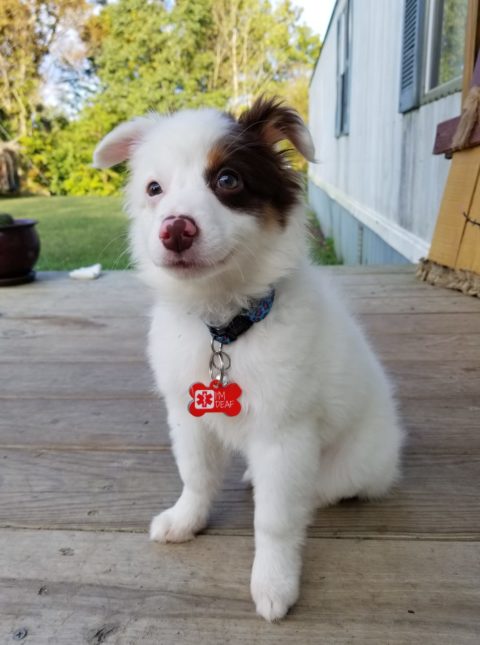

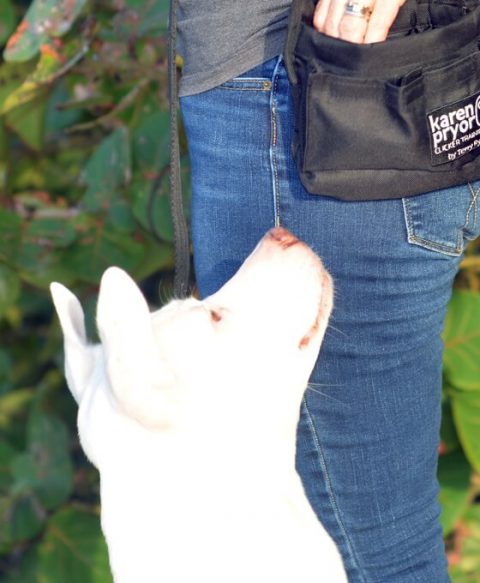 The learner, in this case your deaf dog, is the only one who gets to determine whether or not something is aversive. This means that you have no way to tell ahead of time if this will be something deeply problematic. Too, anytime that you intend to stop or decrease behavior by adding something to the equation, you may run the risk of dangerous consequences, including apathy, aggression, escape/avoidance, and generalized fear. I recommend that you avoid ever using a shock collar as there are alternatives which do not have the potential for harmful fallout.