deaf

September 4, 2017

Food Puzzles for your Dog–Eating the Smart Way. Your Dog Will Thank You!

Terrie Hayward
FullSizeRender 7

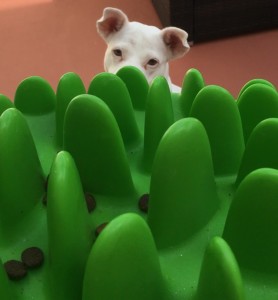
Blanca eagerly peers over this food puzzle: green interactive feeder

Does your dog still eat out of a bowl? Then this post is for you!

Using a food puzzle for your pup’s meals provides both mental stimulatio! Think: fun ways to alleviate boredom while working your dog’s brain in a healthy manner. And, food puzzles provide information for your dog about their environment: consider this-more intel about thier surroundings helps dogs to feel more secure and confident!

IMG_0003

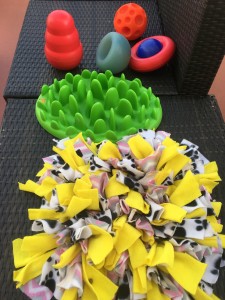
Food puzzles for your dog: snuffle mat, Kong Gyro, Kong Wobbler, Tricky Treat ball, slow feeder, etc.

There is even science behind all of this food puzzle fun. The concept is called, “contra freeloading.” This means that animals will work for food even though identical food can easily be obtained from a nearby dish. This is because dogs (and other animals) are hard-wired to hunt, scavange, and seek out opportunities for food. That is to say that this food puzzle process is more reinforcing than just accessing the food without effort.

Take a look at some food puzzle options in this video–Your dog will thank you for these challenging meal time choices. Food Puzzles for your dog are the way to a happier, healthier meal-time option!

August 26, 2017

Adopting a Deaf Dog

Terrie Hayward

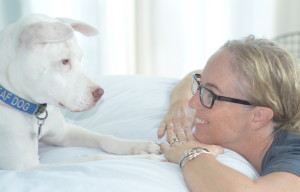
deaf dogHave you recently adopted a deaf dog? Are you confused about just where to start? Would you like some direction as to what to do first?

Great! This post is for you! In addition to a recent post about first steps, these videos will walk you through the process.

STEP 1: The number one spot to begin is by establishing a form of communication. A marker system can help you to do this. In the case of a deaf dog you will use a visual marker. In the video that follows the visual marker is a “hand flash” where you open your hand like a starfish and then close it again.

Markers are always paired with reinforcers. We want to keep up this practice so that they maintain their value! Remember, it is up to the learner to determine the reinforcer’s value.

The marker lets your deaf dog know that, “Wow! That exact thing that you just did has just earned you access to something that you find reinforcing!” We know that behaviors that are reinforced will be repeated, so marking and reinforcing behaviors that you would like to see more of is the way to make that happen!

STEP 2: The next step is to teach your dog to check in with you. A “check in” behavior means that your deaf dog regularly glances back in your direction which allows you to provide further instructions. We can create a regular and re-occurring check in behavior by teaching a “watch me” cue and marking and reinforcing when your deaf dog maintains eye contact with you.

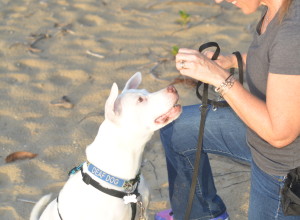
STEP 3: After establishing a communication system and a way to implement that system (your dog regularly makes eye contact with you), a hand target is a great next behavior to teach. Hand targeting is a confidence building behavior and dogs who are confident are self assured, calm, and well mannered.
training

A hand target is also a nice foundation behavior upon which many other behaviors can be built–behaviors such as a weave or a spin which are incompatible with other less desirable behaviors. Too, with targeting you can teach your deaf dog to move onto a veterinarian’s scale or in/out of the car without any physical manipulation nor pulling/pushing.

You can teach your dog to relax and let you have their paw for nail trims or to learn a chin rest target to communicate when they are feeling calm enough for other grooming or veterinary procedures to continue. Both husbandry and fun behaviors can be trained from the hand target base.

A complement to starting out with your deaf dog, would be the pocket guide, A Deaf Dog Joins the Family. Using the techniques in this post will help to set you and your deaf dog up for success!

April 12, 2017

Behavior and Training Japan BAW Conference

Terrie Hayward


(how fortunate!) to be invited by my colleague and friend, Miki Saito to speak at the BAW conference on animal training and behavior in Tokyo, Japan. I was specifically presenting on my two specialties: separation anxiety and deaf dogs. However, of course we generalized to include positive reinforcement training encompassing antecedent arrangement, behavior, and consequences, thus setting the dog (rhino, polar bear, elephant) and person up for success!

It is always a great pleasure to talk with new as well as former colleagues about the science of learning and teaching. By sharing our ideas and thoughts we can continue to expand our repetoir of comprehension and knowledge so that we might always improve upon how to interact clearly and positively.

The theme of BAW was understanding how to use the science of applied behavioral analysis whether at beginner or at an advanced student/teacher level to arrange the environment and orchestrate appropriate consequences to teach and modify behavior.

IMG_6525

We discussed using desensitization and counter conditioning to slowly acclimatize to stimuli in order to help the animal (and/or human!) to feel comfortable and confident. We talked about appropriately reinforcing behaviors that we wanted to see continue or increase. We brainstormed and modeled ways to incorporate each of these tactics into daily interactions.

Creating a global network can help in the realization that none of us are “alone” in our journey towards better cooperation and understanding. As Dr. Susan Friedman states, we are a “tribe” together.

Together we can build and create an ever greater network of support and knowledge which will enable us to better our comprehension of, enthusiasm for, and commitment to best practices in effective and efficient force free communication with all species!

Ready for better dog or puppy behavior?

Fetch the latest training intel–straight to your inbox!